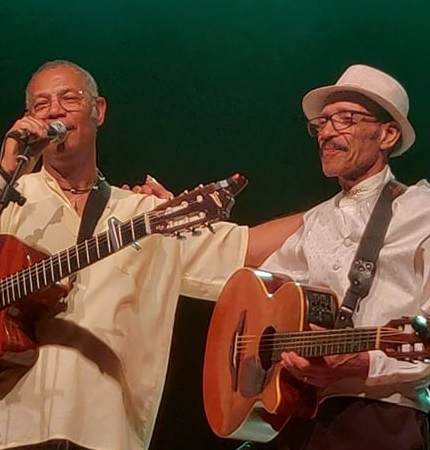
Armando Tito
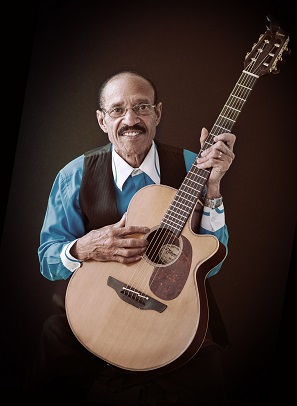
Armando António Boaventura
Mindelo, São Vicente, 1944
Instrumentalist (strings)
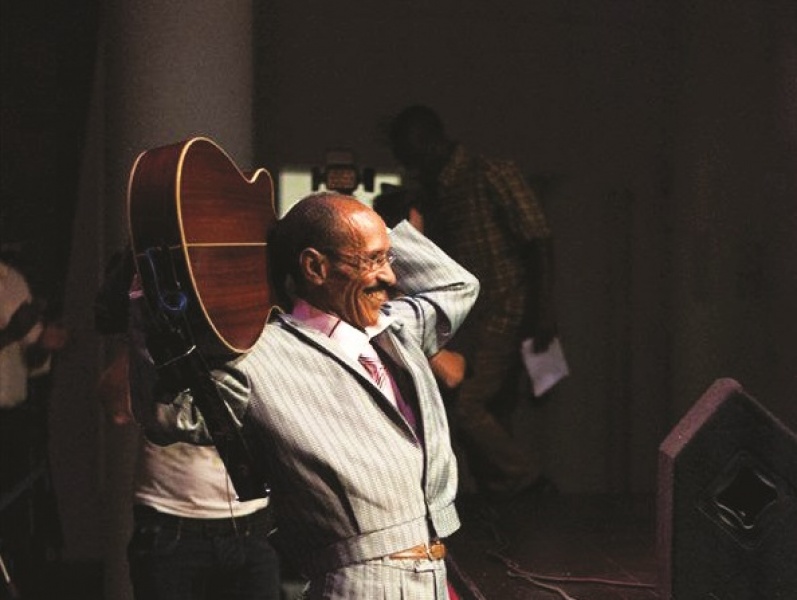
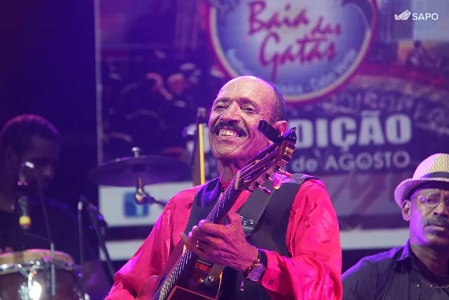
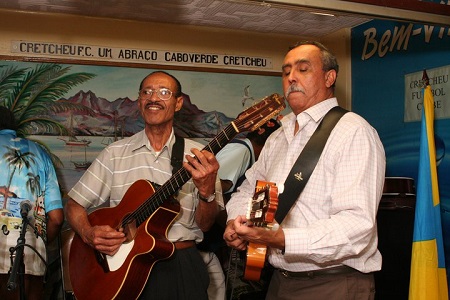
Armando Tito was once simply known as “The Guitar”. However, it was only after more than 30 years as a professional musician – in the 2000s – that he made his first solo recordings, although these were never commercially released. Long before that, in the early 1970s, it was with him that Katchás began his guitar journey.
It is no coincidence that Luís Rendall chose him to accompany him on his rare home recording released under the title Memórias de um Violão. But many other artists, not only from Cabo Verde, have been accompanied by Armando Tito, including Cesária Évora in 1968, on one of her earliest recordings released on disc, alongside Djack Monteiro: the EP Segredo de um Coração. The group was called Conjunto Mindelo. Later, Armando Tito accompanied Cesária on her first major international tours and on her second album of that period, Cesária (1995). Also in the 1960s, he was part of the group Ritmos Cabo-Verdianos.
In the beginning, however, this was not the destiny anyone wanted for Armando Tito. In a household where everyone played music, including his mother, a promise or superstition -due to her having lost two sons named Armando – meant that the third son, who was also the 13th child, was forbidden from learning music. But every afternoon, when she went out to take coffee to the father at work, the boy would unscrew the lid of the chest where the instruments were kept with a small knife to try them out secretly. One day, he was caught playing solo, and they realized he was the best of all.
His father then commissioned Master Baptista – a renowned instrument maker – to build a small guitar scaled to fit his six-year-old frame. From that point on, Armando Tito became practically a professional, enlivening parties alongside a brother and a cousin. At his father’s insistence, whoever hired them was required to pick the children up and bring them back home once the dance was over.
Later he learned carpentry because of a girlfriend whose mother disapproved of the idea of having a musician as a son-in-law. Yet it was music that led him to emigrate to Portugal in the early 1970s, where he participated in the Lisbon-based phase of the group Voz de Cabo Verde. During his tenure with the group – which he left in 1982 – there was a hiatus of about two years, during which he worked as a cook on a Liberian ship. He never forgot his woodworking skills; however, he even crafted beautiful miniature acoustic guitars – about 20 centimeters tall – that actually play!
In 1983, he formed the group Sossabe, which, on various occasions during the 1980s, accompanied Titina, Ana Firmino, and Travadinha in performances in Portugal. Prior to that, – in the early 1970s – he had formed a group with Katchás (guitar), Datcha (bass), and Luís (drums); all were residents of the home of Bia dos Anjos, which operated as a boarding house and hosted dances on weekends, serving as a gathering place for Cape Verdeans in Lisbon. With Armando Tito on saxophone this time, the short-lived group actually recorded an album for Philips – an album which, like the others, was never released.
Throughout his long career, the guitarist has accompanied countless singers. In recent years, he has collaborated with musicians from younger generations – such as the group Raíz, formed in Lisbon. In 2019, Armando Tito was honored at the second edition of the Guitarrada do Atlântico festival, held in Praia and organized by Capital Eventos, with Manuel d’Candinho serving as artistic director.